
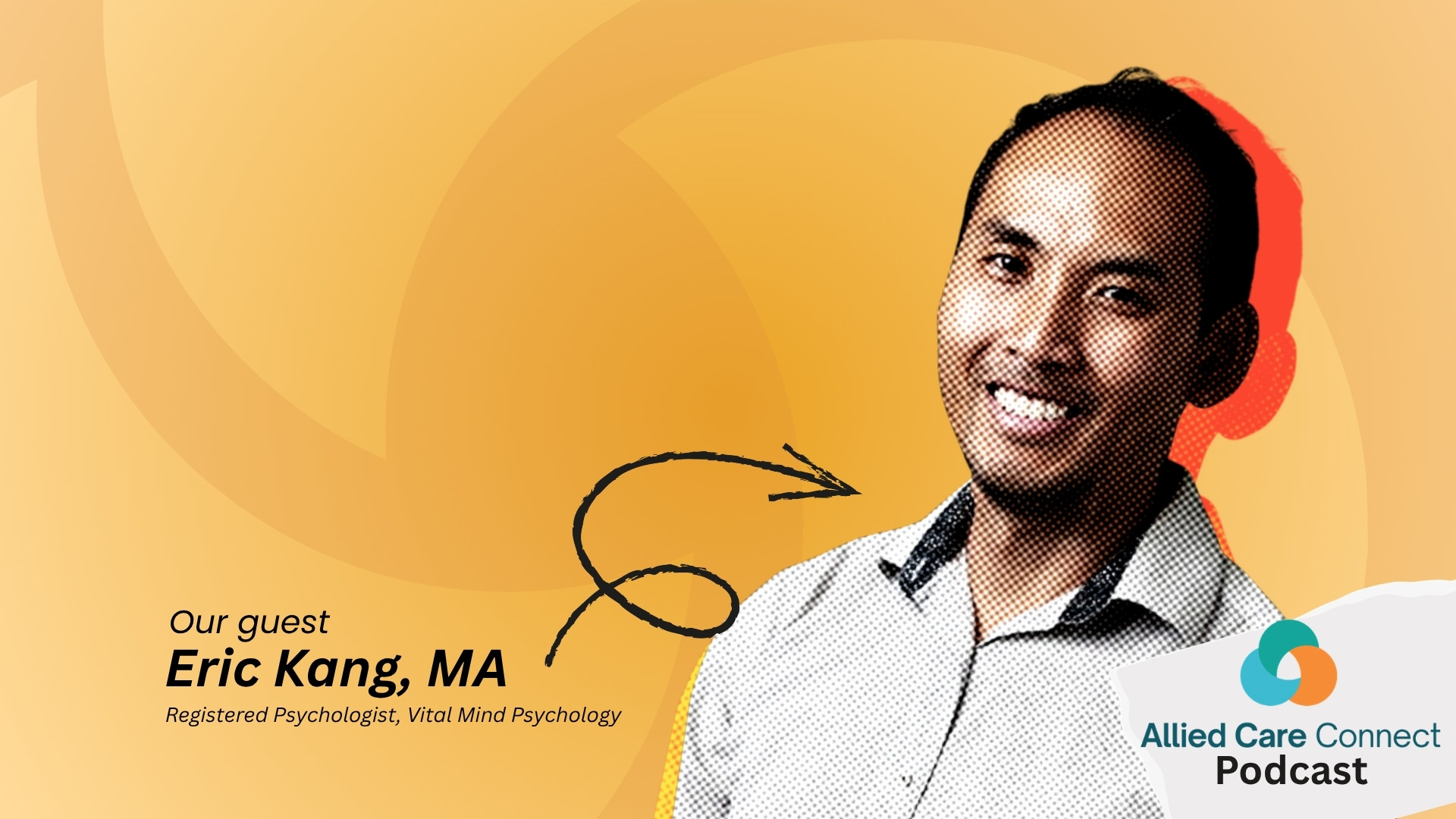
About this episode
Valerie sits down with Eric Kang, a registered psychologist with Vital Mind Psychology in Cochrane, Alberta, for the very first Allied Care Connect Podcast episode. Eric supports teens and adults with trauma, emotional regulation, self-confidence, addiction recovery and relationship issues. They talk about how he got into psychology, his move into private practice and the challenges of running his own business, where imposter syndrome comes from, how psychology can help shift those narratives, and his message for anyone thinking about trying therapy.
Key takeaways
- Imposter syndrome is a cognitive bias: focusing on mistakes and feeling you don't belong, even when you're doing well (12:56).
- It often comes from wanting to do a good job; used "from a place of love" it can push you to grow instead of giving up (18:46).
- Outside perspectives (a therapist, colleagues) help you spot repeated negative self-talk you can't see on your own (21:37).
- Body awareness and slow breathing activate the parasympathetic nervous system and signal safety, which helps with anxiety (24:33, 28:28).
- New to therapy? Fit with your therapist matters most; book a free 15-minute consult to see who you connect with (29:59).
Meet the guest

Transcript
Allied Care Connect (00:00)
Today I'm honored to introduce our first guest on the podcast, Eric Kang. Eric is a registered psychologist with Vital Mind Psychology in Cochrane, Alberta. He supports teens and adults in areas such as trauma, emotional regulation, self-confidence, addiction recovery, and relationship issues. Welcome to the first Allied Care Connect podcast, Eric. Glad to have you here.
Eric Kang (00:33)
Thank you, Valerie. It's great to be here for the inaugural episode of the podcast series. Thank you.
Allied Care Connect (00:39)
Awesome. Awesome. Okay. My first question for you is how did you get into psychology?
Eric Kang (00:47)
I got into psychology ⁓ at the age of seventeen when I took ⁓ a psychology class in high school. ⁓ And ⁓ you know, any seventeen-year-old, when tasked to try to decide what is the vocation that you are likely going to ⁓ try to commit to for ⁓ ideally the rest of your life, is kind of what people say. ⁓ I really didn't have any ideas other than
Eric Kang (01:16)
psychology because it was the most interesting class that I was taking at that time. And so ⁓ when it came time to ⁓ picking a major in post-secondary, I found that it was interesting enough for me, even though I had no idea ⁓ really what I wanted to do with it. I thought maybe research back then or working in some sort of lab. But it took me to ⁓ the realm of counseling psychology, of which
Eric Kang (01:45)
I'm very grateful for as it is now my job as a psychologist, ⁓ to do counseling with people. And so in a way I kinda got lucky that what I found interesting then is something that I still find interesting now.
Allied Care Connect (02:01)
⁓ Mm ⁓ mm yeah, for how many years have you been practicing?
Eric Kang (02:08)
Hmm, ⁓ probably close to twenty in some capacity in the realm of health and mental health. And so I was kind of fortunate to have found a job straight out of my undergraduate working in a hospital setting where I could see people, ⁓ even in a kind of a different capacity, maybe not so much one to one, but doing intake, doing a little bit of testing, ⁓ running a a small group.
Eric Kang (02:39)
for for patients there ⁓ and I gained a lot of experience there. And so ⁓ I think for most people ⁓ coming into the profession, you ⁓ kind of have to continue on with schooling before you can get that kind of education, ⁓ hands-on education. And so I was able to test out, you know, if this really was for me. And I had continued to enjoy the work that I was doing and learned a lot, just meeting with people, understanding
Eric Kang (03:07)
what their problems were. This was an addiction center. So understanding the connection between mental health ⁓ and addictions ⁓ and ⁓ just even starting to talk to people and learn more about what a psychologist might be doing. So that was a cool experience for me. ⁓ And I've been able to grow and learn from a number of different ⁓ areas and settings ⁓ since that time, ⁓ including the hospital, a functional medicine center,
Eric Kang (03:37)
long term care center and then now private practice.
Allied Care Connect (03:41)
Yeah. What was the journey like from these different settings and what drew you to private private practice?
Eric Kang (03:49)
The journey's been ⁓ an interesting one. ⁓ So I think it was good for me to be in the hospital setting because I worked in a multidisciplinary system where I got to be around nurses, psychiatrists, other psych psychologists, social workers, occupational therapists, ⁓ and ⁓ so I got a quite an eclectic blend of perspectives and ideas around how people approach ⁓ mental health.
Eric Kang (04:19)
And I I found that after some time that setting really wasn't for me. I think it was a bit constricting in terms of the areas that I wanted to ⁓ look further into. And so I had to ⁓ move to move out. ⁓ I had to end that ⁓ relationship with Alberta Health Services ⁓ and ⁓ start to dabble in other areas of which
Eric Kang (04:46)
It was it was not easy to do that, and I think I understand why people stay in that system for a long time, actually, because there is a ⁓ quite a benefit of ⁓ I guess the sense of security and safety that comes with this kind of setting. ⁓ And so it wasn't easy to to leave that, but I found myself ⁓ trying to learn in
Eric Kang (05:13)
multiple different areas afterwards and I found that I was able to develop a more robust way of understanding ⁓ the connection between mental health and physical health and biology and all of these things.
Eric Kang (05:31)
are still very interesting to me. And so the journey has kind of taken me into ⁓ I guess having f more ⁓ freedom and control ⁓ and ⁓ I think private practice is the venue for me to really dive into whatever it is I want to learn more about. And I can start to practice ⁓ modalities or ways of treatment that ⁓
Eric Kang (05:59)
maybe are a little bit outside of the ⁓ traditional ⁓ norm, let's say.
Allied Care Connect (06:08)
Mm. Mm-hmm. Can you expand more on that? The
Eric Kang (06:12)
So one of the modalities I use is called AIT, which is advanced integrative therapy, ⁓ and it is for ⁓ treatment of trauma. ⁓ And so I I've used this ⁓ over the last few years ⁓ with great success. And the way that it works is it's kind of a somatic energy healing modality. And so with trauma, we go into the body because trauma is not so much a cognitive
Eric Kang (06:39)
Issue. I think people who have experienced trauma know they're not eight years old anymore when that trauma occurred or however long ago that happened. But their body feels that way when they think about you know the situation that was traumatic for them. Their body activates in a way that's like it just happened yesterday. ⁓ And so ⁓ with energy healing, you know, ⁓ this is not so much a
Eric Kang (07:09)
method that is ⁓ so much supported by
Eric Kang (07:15)
The the typical approach that a lot of psychologists might take. Talk therapy, you know, they will say like CBT, ⁓ the word evidence-based gets thrown around a lot, even though there is a lot of evidence for these other modalities, just not investigated to the same rigor as these other ones. ⁓ I'll say yet. ⁓ And so ⁓ as I get to kind of be on the the cusp of
Allied Care Connect (07:20)
Like top therapy.
Eric Kang (07:43)
you know, these kind of modalities, it's really interesting to watch as like ⁓ people find a lot of benefit very quickly from something like energy healing ⁓ in in ways that talk therapy will really struggle to touch. And so I find that in the private practice realm, you can you can explore wherever your heart desires, whereas I think in more traditional environments where these, you know, other modalities tend to propagate, ⁓ they might not be so open.
Eric Kang (08:14)
to trying some of these things, even though and let's say even if it's just anecdotal, it's quite a lot of anecdotal evidence that I've found so far as to treating trauma through this modality has been very, very beneficial for my clients.
Allied Care Connect (08:29)
⁓ Thank you. I'm ⁓ interested in as well in ⁓ in your shift towards private practice. What are and having your own business? What are the challenges that you've had to face? You've mentioned a lot of the freedom and being able to practice psychology ⁓ in whatever ⁓ way interests you or whatever it is that benefits your client the most. ⁓ it's more you're more open within this realm. And
Allied Care Connect (08:58)
Yeah, I'm curious as to what was the journey like from like starting your own business.
Eric Kang (09:05)
Hmm. ⁓ Well, if if you want full autonomy, you have to also incur full responsibility. And so ⁓ setting up the practice was of course scary because you are fully responsible for all of the setup, ⁓ the admin, especially when it's just you, like it was when when I just started, honestly, like a lot of this was like answering the phone and then taking out the garbage, and then ⁓
Eric Kang (09:35)
Setting up my calendar and then seeing a client and then whatever else, answering all the emails and phone calls and ⁓ thinking of marketing and all of these kind of things. ⁓ yes, exactly. ⁓ Yes. And so ⁓ being very responsible ⁓ for ⁓ the ⁓ kind of building building that system to where it is today. And so we're gonna be at two years.
Allied Care Connect (09:47)
Wearing the many hats. Yeah. Yeah.
Eric Kang (10:04)
Two years old coming up here pretty soon ⁓ and ⁓ thank you. And I'm and I ⁓ I feel like it has grown ⁓ quite immensely since ⁓ when I first started. And so it was a lot of anxiety at first, for sure, because that's the cost of autonomy, is you have to be fully responsible for everything. ⁓ And ⁓ there kind of isn't really a safety net. It's like figure out figure out the thing so that you can keep going.
Allied Care Connect (10:07)
Congratulations.
Eric Kang (10:34)
If there's a problem, you have to find a solution, or you have to talk to somebody who can help you, or do you know, problem solve. And so ⁓ I guess the the good news is, you know, it feels a lot easier to run this ⁓ now. And I have a great team of other psychologists ⁓ that are doing fantastic work. ⁓ And so that ⁓ is also a benefit because I have I feel like I have a really cool community.
Eric Kang (11:03)
To kind of bounce ideas from. We do supervision every week. And so we're all very tuned into ⁓ our various practices and we can give each other guidance ⁓ constantly. And so ⁓ that part I really, really like about private practice because, ⁓ you know, even though there's a multidisciplinary team ⁓ in the hospital setting, I did feel like it was a bit fractured, as in
Allied Care Connect (11:31)
Hmm.
Eric Kang (11:33)
People weren't always able to, ⁓ at least where I was, to ⁓ to fully connect with each other ⁓ and offer ⁓ perspectives. ⁓ It just didn't feel the same as sort of the team the way that we're doing it right now. And so ⁓ we're just very open. I think. We're we're just very open to things and we can ⁓ bounce ideas that are maybe a little bit
Eric Kang (12:02)
off the path, we can explore things that ⁓ maybe other people might not. And so things like energy healing are like on the table. ⁓ And ⁓ I think we're all just very curious. And so I think you know maybe I see Vital Mind Psychology as this crucible where we're all kind of getting better ⁓ as humans, ⁓ like even the practitioners, because we're
Eric Kang (12:28)
kind of learning about ourselves, we're working on ourselves in this way, of which I think it really benefits the people that we see when we're doing this work.
Allied Care Connect (12:36)
Yeah. ⁓ Thank you. I just want to touch a little bit more about ⁓ imposter syndrome, which is, you know, a ⁓ something that a lot of practitioners experience even with decades of experience in people's belts. Can you touch more about that?
Eric Kang (12:56)
So imposter syndrome is something ⁓ I've been kind of researching a little bit more. ⁓ we just put out a first episode of our podcast on imposter syndrome. ⁓ and so I've been thinking a lot about it ⁓ and I I I see it ⁓ as a cognitive bias ⁓ towards a certain type of information. So people with imposter syndrome will often feel like they don't belong in a particular place. So if it's
Eric Kang (13:25)
Related to a job, for example. They'll think, ⁓ you know, I'm not very qualified, ⁓ or ⁓ I I don't know what I'm doing. Everybody else seems to know what they're doing. ⁓ And they're gonna figure out at some point that I don't really belong here. And so there's kind of an underlying anxiety, ⁓ and there's this feeling that they're different from other people. ⁓ And I want to differentiate this from
Eric Kang (13:54)
Maybe somebody who has depression or low self-esteem, where they're they're kind of like they don't feel like they're worthy. In a lot of areas, imposter syndrome tends to be ⁓ specifically focused in ⁓ one area or a few areas, or there is a global version of it, but it is very different from just feeling depressed or ⁓ kind of sad about yourself, and that you are paying more attention to ⁓ the information, let's say the data.
Eric Kang (14:24)
That informs you not being capable ⁓ at something rather than the information that is. And so somebody with imposter syndrome tends to be more fixated ⁓ on the mistakes ⁓ that they make. ⁓ You know, if they get like ⁓ a 90% in something, they'll be like, my god, see the that I didn't get a hundred, that ten percent means that I didn't do enough, and they will really hyperfixate on the elements of their work.
Eric Kang (14:54)
That maybe aren't there. And they're people with impostus and tend to be very kind of hard on themselves about this. ⁓ And so ⁓ I think a lot of this involves changing the way that you think, looking at information in a more ⁓ balanced way, where that you're really giving yourself you know the kudos for the things that go well, especially if you're learning, which
Eric Kang (15:23)
We all are. And yeah, and to be gentle with ourselves ⁓ about being in that learning process. Right. And and so I I think that ⁓ we we have to reframe things so that it's this more gentle kind of story around imposter syndrome where it's like I'm learning and getting better, and of course I'm gonna make mistakes. ⁓ As an example, rather than I have to be perfect.
Allied Care Connect (15:25)
Constantly. Yeah.
Allied Care Connect (15:50)
⁓ Yes.
Eric Kang (15:53)
Or I I have to ⁓ show that I am competent all the time, of which, you know, there's a lot of pressure from ⁓ a narrative like that, if that's something you think, right?
Allied Care Connect (16:03)
Yes. Yeah. I'm curious as to ⁓ narratives. ⁓ Are do these narrat to ⁓ pertaining to like imposter syndrome, do these exist before or ⁓ is this learned?
Eric Kang (16:21)
Yeah, narratives come from ⁓ all sorts of things. And so growing up, you will start to inherit narratives from ⁓ the people around you, mainly your parents. ⁓ And so your parents will give you messages like you can't you can't spend all your you can't spend a lot of money because you won't it's really hard to ⁓ earn money, for example.
Eric Kang (16:48)
So you have to be very careful with what you spend your money on. And so somebody who receives a message like that will start to internalize the idea that money is scarce and that they they will have to be very careful about that. ⁓ And so ⁓ you might develop a mindset where you you really think about every single thing that you buy, which is not such a bad thing, but you might also develop the the sense of scarcity, like there's never enough.
Eric Kang (17:16)
And so you always might be really hyperfixated on worrying about money and not having enough of it ⁓ and feeling like there is just ⁓ a small amount in the pot and that you can't that you have to be very wary about ⁓ when it leaves you. And so these these these are just examples of like how ⁓ some of these narratives start. And so you have narratives about everything, you have narratives about ⁓ say money, you have narratives about how relationships work.
Eric Kang (17:46)
You have narratives about who you are ⁓ and what you're capable of ⁓ and where you belong ⁓ and what what health is. All of these things are things that you start to internalize. And of course, you have control over some of these elements as well, but ⁓ it really takes conscious effort to shift a narrative that you might have, especially one that does not serve you.
Eric Kang (18:15)
But you're you people can get stuck in, right?
Allied Care Connect (18:18)
Yeah. Yeah. I want to circle back on imposter syndrome and perhaps narratives around ⁓ career or growth. Because you do we will experience ⁓ we experience imposter syndrome when we help people ⁓ or when we're challenged or or if it's like a first time interaction with a client or or an organization. It's yeah.
Eric Kang (18:43)
Right.
Eric Kang (18:46)
I don't think imposter syndrome necessarily is bad. I I think ultimately it comes from this place of of love, of like wanting to do ⁓ a really good job and feeling like you are not equipped to do that. And in some cases this can be a catalyst for somebody to like learn and grow ⁓ and become a better version of themselves. So it can be motivation. Or I think for other people it can be very defeating.
Allied Care Connect (18:49)
Mm-hmm.
Eric Kang (19:13)
So you f you have this imposture syndrome and it just takes over. Like you're like, I can't do this. ⁓ And some people in that situation might be prone to giving up. ⁓ But I think the origin of it ⁓ is the feeling of wanting to do well, which I think if you ⁓ are feeling imposture syndrome, it's good to know that this is this is coming from a good place. And I think if you use this feeling as a fuel source, you can actually get better at something.
Allied Care Connect (19:18)
Yeah.
Eric Kang (19:42)
Very quickly. But I would I would kind of urge people to do this out of a place of love. And so you can use this ⁓ imposter syndrome, be like, I I care about my job, I care about doing well, and so I'm going to ⁓ find a way to do my best to like learn as much as I can, talk to the right people, just like really strive to do great. But it can also take on the fear flavor, which is like.
Eric Kang (20:11)
People are gonna find out I'm screwed. You know, this is not gonna be good. And ⁓ peop it this can give people massive, massive anxiety. For for years people can get stuck in this. ⁓ And but the other thing I'll say is that I think that
Allied Care Connect (20:24)
Yes. ⁓
Eric Kang (20:30)
The people I respect the most are also people with imposter syndrome. Like you kind of can't think that you're too amazing at something, ⁓ and and be really good at it, ⁓ usually. Like you can't have too much of an ego. Like we're all kind of students of life. And I think it's it's good to be humble enough to feel like you're a bit of an imposter at times. I think it means that you're in a space where you can you can grow.
Allied Care Connect (21:00)
⁓ Yes. And I I'm thinking about what you said earlier about ⁓ putting in ⁓ a conscious effort for these narratives to shift ⁓ and the effort that it takes. ⁓ can you share with us many ways where psychology can help you shift ⁓ and ⁓ maybe bring that imposter syndrome?
Eric Kang (21:00)
You are being challenged, that kind of thing.
Allied Care Connect (21:27)
kind of in the backseat versus it driving your behaviors or driving your your ⁓ the way you show up as a professional.
Eric Kang (21:37)
Hmm. ⁓ I think people can get stuck in their own perspectives. ⁓ And it is really important for every human being to expose themselves to ⁓ alternative perspectives. ⁓ because alternative perspectives have a lot of information that you can't see by just being you, like you're too close to you. And so somebody looking at you from a certain distance can see something that you can't.
Eric Kang (22:06)
And so I'll share that, ⁓ you know, I it in my own imposter syndrome journey, I've had practitioners in the past tell me that I'm very hard on myself. And it's been a constant ⁓ theme that's come up when I've talked to people. And so when I hear this enough times, I go, yeah, ⁓ that is something that I do, even though like I kind of know that, but it's hard to recognize that.
Eric Kang (22:33)
Perhaps because I just have thoughts as a person. And the more thoughts repeat, the more normal and constant they become. ⁓ And and when they become constant, it's sometimes hard to ⁓ really see them ⁓ as a pattern. But when ⁓ you can externalize that pattern and somebody can tell you what they know and they can ask questions and explore that and kind of give you a perspective of like you can change without.
Eric Kang (23:02)
having to be hard on yourself. Like you can you can make mistakes and not have to beat yourself up for something like that, for example. Then ⁓ you know I might go, that's ⁓ you're right. Like that's really interesting. I guess I don't have to do that. And so a psychologist or going to counseling ⁓ can really uncover patterns ⁓ and ways of thinking, ways of behaving
Eric Kang (23:32)
That aren't serving ⁓ somebody's highest good. ⁓ So for me to receive that feedback from people, it has been a journey to ⁓ shift that for myself. Because it was like pretty constant for me, like a negative kind of self-talk in the past. But having that outside perspective and understanding it more has ⁓ allowed me to consciously shift that. Like, I shouldn't be so hard on myself. And then you make
Eric Kang (24:00)
decisions over time to slowly kind of move that and replace that that narrative ⁓ with a new narrative.
Allied Care Connect (24:10)
Coming back to ⁓ the part where you talked about AIT, is there a connection with the way we feel imposter syndrome in our bodies? ⁓ And is is is it something that you also apply to kind of consciously shift out from negative self-talk?
Eric Kang (24:30)
Mm.
Eric Kang (24:33)
I think there's a lot of benefit for being able to ⁓ what's called introsphen, being able to kind of understand the signals of your body, because your body will give you a lot of information about what what it needs. And so with the basic ones, it's like you're you're hungry, you're thirsty, you need to go to the bathroom, you know, your muscles are sore, you should get up and stretch them, ⁓ this kind of thing.
Eric Kang (25:02)
But if you're paying attention to other sensations of your body, emotions, things that arise when ⁓ you you think about something traumatic that happened, ⁓ or you think about ⁓ something that happened to you in your life that's affecting you, your body will give you ⁓ signals as well. And so sometimes there's a tightening, sometimes there's ⁓ anger.
Eric Kang (25:29)
That comes sometimes. There's sadness that comes with these things. And so a lot of the work I do with people is ⁓ creating this ⁓ greater connection with people's bodies because people can experience something, but they may not be able to practice being able to feel into it. ⁓ And often people ⁓ make the attempt to ⁓ mitigate certain emotions or certain sensations. ⁓
Eric Kang (25:59)
An example would be ⁓ anxiety. ⁓ Right? People are like, I have a lot of anxiety, and we tend to frame this as a very negative thing. But anxiety ⁓ is the defense mechanism that all people have to keep them safe. And so it scans for danger or potential danger and alerts you to it. And so when it uncovers something that could be potentially dangerous to you, ⁓ you start to feel anxious.
Eric Kang (26:29)
And so this is very beneficial for staying alive, but of course your alarm system be can become very sensitive and start to alert you to things that maybe aren't actually all that bad for you. And so paying attention to that signal allows you to better understand why is this coming up for me? What does it want to protect me from? And if we can look at it from that lens, we can start to ⁓ do something about it.
Eric Kang (26:58)
So you can learn to soften an anxiety response, for example. You can learn to ⁓ release ⁓ traumatic energy in your body. You can go into the body and feel into these things, which helps you to heal from them.
Allied Care Connect (26:58)
Yeah.
Allied Care Connect (27:18)
Okay, thank you. So I just like to share a little bit. I I've practiced yoga for many years ⁓ and they always say to come back to your breath is breathing a tool to scan and c and like you said, have that space for interception where you can become more adept to the signals that come to you. Cause I I'm assuming when it's the body reacting, it's not yet ⁓ as ⁓
Allied Care Connect (27:48)
coming into the conscious mind. Does that make sense to you? Or when threats are around you, it might not fully ⁓ be conscious right away.
Eric Kang (27:50)
Hmm. Yeah, that's true.
Eric Kang (27:59)
It's true. Yes, very true. And so ⁓ it as you know from yoga, ⁓ if you just do the poses without the breath component with it, you're really receiving probably not even half the benefit of yoga. Yoga is designed for the movements to match the inhale and the exhale deep into the body so that you can ⁓ start to connect there. ⁓ And ⁓ the breath actually is one of the
Eric Kang (28:28)
Easiest ways to start to ⁓ activate what's called your parasympathetic nervous system. So for something like anxiety, some deep breaths actually signals to every cell in your body you're safe. Because that's the only time you ever breathe like that is when you're safe. Those nice deep and slow breaths. And so ⁓ doing that kind of breathing starts to ⁓ affect your physiology within 15 seconds.
Eric Kang (28:56)
And so breath is really important to to a lot of mental health. ⁓ And I can I can almost see, you know, sometimes people are holding so much tension. When I get people to just even take a few breaths, they're starting to soften quite a lot and just let let that tension go and relax their bodies. ⁓ And so the breath is quite a gateway to a lot of somatic benefits ⁓ and
Eric Kang (29:26)
and it is the anchor to ⁓ creating awareness to the body ⁓ and to get out of you know thinking and cognition. So it's yeah, exactly. So ⁓ so it's a wonderful practice. I think everybody should practice.
Allied Care Connect (29:35)
Ruminating. Yeah. All right.
Allied Care Connect (29:44)
Awesome. ⁓ I just have one more question for anyone who is thinking about ⁓ booking a psychology session or trying therapy. ⁓ What would be your message to them?
Eric Kang (29:59)
Yeah, you know, sometimes I get people ⁓ where it's their first time coming in for counseling and they're nervous and they have a perception of what it is. ⁓ And sometimes it's based on like what they see in the movies, and it's gonna be ⁓ really, I don't know, serious and stuffy, and at times it is serious. And I think sometimes you have to go i into those realms. But I also feel like ⁓ the connection between the therapist and the client is really the most
Eric Kang (30:28)
Important element ⁓ of what you would call treatment outcomes, what you're going to get out of, you know, count the counseling process. And so it's really important to find somebody that you jive with, that you have this good connection with, that you feel that you're comfortable opening up to, and that they are there to, you know, listen and understand and offer feedback and perspective and help guide you along the path to.
Eric Kang (30:57)
The place that you want to be. ⁓ And ⁓ sometimes you might have to try a number of people in order to do that. ⁓ It's kind of like anything. Like you're ⁓ if you're trying to meet, you know, a partner, you're gonna have to go on a bunch of dates often to try to understand, you know, what's this person like, what's this person like. And so ⁓ finding a psychologist is y ⁓ sometimes just
Allied Care Connect (31:15)
Mm-hmm.
Eric Kang (31:26)
seeing who you connect most with. ⁓ And ⁓ I I would say book a free session, ⁓ a 15-minute session, consult session, and just talk with that person and get to know what their style is, what their perspectives are, ⁓ how they conceive of ideas. ⁓ And that might give you a good hint as to ⁓ how that person might be able to work with you to get you to where you need to be. And so
Allied Care Connect (31:28)
So ⁓
Allied Care Connect (31:36)
Yeah. ⁓
Eric Kang (31:55)
I would say it's probably, you know, often it's worse in people's minds what the process is gonna be like. ⁓ And you know, we've had a lot of people who said, like, this is totally different than what I thought it was gonna be. In a good way. Like this is much, ⁓ much more enjoyable ⁓ or beneficial or f even fun, you know, than I thought it was gonna be. And so I think if you're somebody thinking about ⁓ doing counseling.
Allied Care Connect (32:10)
In a good way.
Eric Kang (32:25)
Give it a try and ⁓ talk to a bunch of people ⁓ and start to explore, open that door and just see, you know, what what might be there for you.
Allied Care Connect (32:38)
Amazing. Thank you so much for your time today, Eric.
Eric Kang (32:42)
very welcome. Thanks very much.
Allied Care Connect (32:44)
Yeah. So thank you to all our listeners out there, where can they find you?
Eric Kang (32:50)
So we're at Vitalmind Psychology.com. ⁓ If you're in the Cochrane area, you can come see us or Calgary area ⁓ in our office there. We do sessions online for people in Alberta. We also just launched the Vital Mind podcast, which is currently on Spotify ⁓ and I guess soon to be on other platforms. ⁓ and imposter syndrome is the first episode, but we'll have
Eric Kang (33:18)
Other episodes coming soon on other topics ⁓ that are instructive, ⁓ kind of like deep dives into certain elements around psychology as well as open form conversations with psychologists or people in the community where we just talk about ⁓ whatever. Whatever we're into.
Allied Care Connect (33:39)
⁓ Awesome. Thank you so much, Eric.
Eric Kang (33:45)
Thanks, Valerie. Bye bye.
Allied Care Connect (33:46)
Hi. ⁓