
About this episode
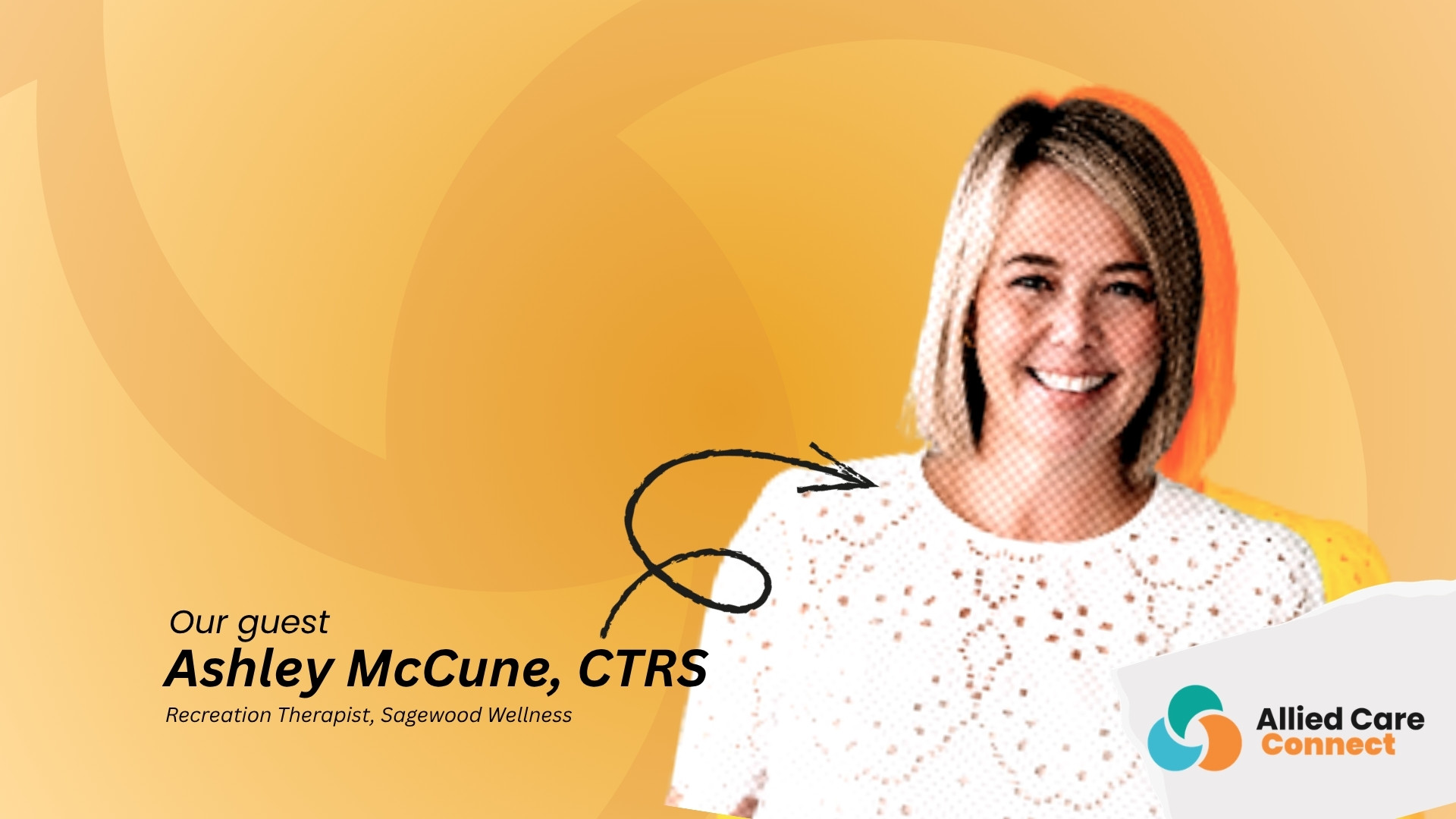
Valerie talks with Ashley McCune, a Certified Therapeutic Recreation Specialist and co-founder of Sagewood Wellness in Cochrane, Alberta. Ashley supports older adults and families through individualized, evidence-informed recreation therapy and aquatic therapy focused on well-being, independence and quality of life. They cover Ashley's path from lifeguarding into recreation therapy, when someone might be referred to a recreation therapist, what makes water so special for therapy, safety considerations, and common misconceptions about recreation therapy.
Key takeaways
- Recreation therapy is an evidence-based discipline that uses meaningful activity to build skills like planning, turn-taking and communication (11:47).
- People are referred for goals such as cognitive stimulation, finding interests again, and reconnecting as a family (14:22–16:52).
- Water lets people practise things they can't on land; turbulence and obstacles can be created in the pool (20:10).
- Ashley walks clients through what to expect at the pool, from the front desk to the change room, to ease anxiety (26:30).
- Recreation and aquatic therapy aren't title-protected, so check a practitioner's credentials (28:53).
Meet the guest
Transcript
Allied Care Connect (00:12)
Today I'm joined by Ashley McCune, a certified therapeutic recreation specialist and co-founder of Sagewood Wellness Incorporation in Cochrane, Alberta. Ashley supports older adults and families through individualized, evidence-informed recreation therapy and aquatic therapy with a focus on well-being, independence, and quality of life. Welcome to the show, Ashley.
Ashley (00:38)
Thank
Thanks Valerie.
Allied Care Connect (00:41)
Thank you. Awesome.
Okay, let's dive into the first question.
Ashley (00:46)
For sure.
Allied Care Connect (00:49)
Can you share about a bit about your background in aquatics and what led you into recreation therapy?
Ashley (00:54)
Hmm.
Okay, so I'll try to kind of narrow it down a bit, but I would say, like many recreation therapists, I started out working as a lifeguard swimming instructor, camp counsellor, as a teen. When I was in my early 20s, I took the opportunity to go work up in the Northwest Territories as a traveling waterfront director in the day chill region.
Loved that experience coming from Southern Ontario. It was very eye-opening. It was an absolute privilege to be able to see that part of the world that, you know, many people never get the opportunity to visit. So loved my first year up there and went up for three more summers to run the seasonal swimming pool up in Fort Simpson.
The pool there was, I think, three feet deep, so barely up to my waist and about 15 meters long. And so for the community of Fort Simpson, at the time there were about 1,200 people living there, the pool became a hub in the summertime. So I would teach advanced aquatics training, swimming lessons to all the kids in community, school-based swimming lessons in water safety, aqua fit.
You name it, we did it at the pool. We were operational seven days a week. It was a really busy place. And so that definitely shaped my career. Following my undergrad, I pursued postgraduate training in addictions counseling. So I did that for a number of years, specifically working in youth addictions in Northern.
Alberta, working for ADAC back then, then AHS, traveling to remote communities, doing education, working with outreach schools in the area, and subsequently moving to Calgary where I worked in a school-based mental health program.
So while I was at home raising kids, I took the opportunity to really reflect on what I wanted to do when I returned to the workforce. So pursued a degree in recreation therapy. So back when I had done my undergrad and other schooling, I didn't know about recreation therapy. I didn't learn about it until I had worked in the field. And so it really kind of brought together all of my passions.
You know, my approach to working with youth up north was very experiential. And so I pursued the University of Lethbridge program while at home raising two babies and graduated and have since been working in the field mostly with youth and mental health. But last year I took the jump into private practice. And so really wanting to focus on
older adults because I really have learned that they are an under-service population and bringing my background in aquatics into it. I connected with Tanya Selwich-Hoffert who has been doing aquatic therapy in the area here for the last 17 years and so took some training with her.
and have been working alongside her and Healing Waters Foundation to increase accessibility to aquatic therapy for individuals with disabilities predominantly. So again, so many shifts in my career when, you know, just when I think I know what I'm doing, like I said, with my practice, it's really shifted and I'm now, you know, spending a lot more time working with persons with disabilities and learning a lot along the way.
recently took training, some very advanced training in aquatic therapy. The methodology is called Water Specific Therapy Halowick. So we had a trainer come from the Netherlands to come and teach at the pool here in Cochrane. So after 46 hours of intensive training and five days, I completed my exam and
past the competency and so really excited to be able to offer this to community and so again kind of shifting back into working with those older adults. The HALWIC methodology really focuses on learning skills in the water where it's safe so fall prevention things like that you know really important skills of daily living like getting out of bed and so there are
specific exercises you can be doing in the pool that translate to goals on land. So I'm really excited to be offering that at Spray Lake Sports Centre in Cochrane here in the fall. So, yeah.
Allied Care Connect (06:13)
That sounds so exciting. And I love asking this first question because you can see the passion of the practitioner and the journey that led them to the present moment. Yeah, so thank you for sharing your story. I just have a bit of a follow-up question. When you mentioned that you were working in the Northwest Territories, you said that it was eye-opening. And can you elaborate more on what was eye-opening word in there?
Ashley (06:15)
Okay.
I think just the lack of resources available. You know, the swimming pool program that I worked in was, I believe, developed in the 1980s. And so there are these above ground swimming pools all over Northwest Territories, none of it in remote communities to help teach water safety, because that's a really big thing up there. A lot of people that
live on the land, you know, or maybe at risk of drowning. And so this was an initiative by the government. So I can't even remember how many pools are kind of scattered across the Arctic. But they're only open for a few months of the year. They're all above ground because of the permafrost. And so they would often have to bring people from the south as they as they call it to work up there and train local staff.
initiative was meant to allow the communities to become self-sufficient. But I was up there in the early 2000s and so, you know, often it was really difficult. I had a great group of youth that I had trained while I was up there. And so, very important work. But again, the resources, so the pool I worked at, you know, there was a lot of...
challenges, I guess, with accessibility to chemicals and equipment and things like that. This was before the days of Amazon. So if I went up there and ordered things, often took months for them to come in because for a part of the year, Fort Simpson was a fly-in community only because the ferries were out of the water and the ice road wasn't in yet. again, access to basic goods and services was quite limited.
And again, I think being so remote as well. Just yeah, limited sort of expertise of people to work in community that could. Yeah, sorry. You lost me there for a second. I think you know, I think the community really comes together beautifully though, like it's one of those things where I was even mentored up there by a teacher that was
Allied Care Connect (08:43)
Yeah.
It's okay. It's okay.
Yeah.
Ashley (09:02)
working in the same aquatics program in the same community where I was, you know, years before. And so she supported me throughout my time there and kind of helped guide me in just getting familiar with the community and helping me to build that trust there as well.
Allied Care Connect (09:24)
Thank you for that. That's that's an incredible experience you've had. In yeah, and
Ashley (09:30)
Yeah, I remember
the first, no it was the second year I had gone up there and I kind of knew what to expect in terms of groceries. So coming up there mid-May is when you know there's breakup and you know it's difficult to get goods and so the grocery shelves would honestly be empty. And so I think for about three days the only thing I had to eat were Oreos which I mean it's not the worst thing. But again it's an amazing community. I had a friend
bring me over to her house for meals and deliver lunch at the pool for me, because everybody really, you know, tries to support one another and work together. But yeah, amazing experience.
Allied Care Connect (10:03)
Yes.
That's beautiful. Yeah.
Another question that I would have is, how would you explain recreation therapy to someone who doesn't know about it?
Ashley (10:16)
Sure.
So as somebody in private practice now, I've had to do a lot of explaining and yeah, just trying to build people's understanding of it and the value. I had come from an environment where I was working in a day hospital program. So everybody there's familiar with recreation therapy, values it, of understands.
the role within the clinical team, but in community. When you say recreation therapy, I've had a lot of people say, well, why do I need help to, you know, do this, that, or whatever? So it's not necessarily something that everybody needs. So how I have kind of explained it in the most simplest way is that I use recreation and leisure to support client goals. So, you know, if I have, if I'm working with somebody who is
maybe needing some support with regulation. We might explore some different sensory art-based activities or we might do some different things in the gym. So again, the intervention really aligns with the client goals. So it might look like we're just playing board games, but...
Allied Care Connect (11:41)
Yes.
Ashley (11:47)
We're focusing on some of those executive functioning skills. So taking turns, planning, communicating. You know, there's lots of things that go into it. And so what I love about recreation therapy is that it is an evidence-based discipline. So I'm always out there reading and learning and trying to explore new ways to support my clients in the most comprehensive and best way possible.
Allied Care Connect (12:14)
Thank you. I know a lot of these practices are always dynamic. Like we're always learning whenever we have a new client or whenever clients have changes within the time period we're serving them. So
Ashley (12:21)
Yeah.
No, I agree. And I think like
the the opportunity for some collaboration as well, because, you know, this this field brings people with so much expertise in so many different areas. I know you and I have connected through the private practice community of practice that you hold. And it's amazing to hear of different opportunities that are out there. You know, like I'd like to share on
how I am implementing therapeutic horticulture into my practice because I think, you know, it really has tremendous benefits and it's one of those things that's a bit unique. So bringing that in, kind of teaching how it can be utilized is quite valuable.
Allied Care Connect (13:16)
Awesome. And just looking back to your background and working in the Northwest Territories, that sense of community is pretty much ingrained in the recreation therapy field.
Ashley (13:29)
It is a very small community. so having that ability to connect with other practitioners, I know when I took the leap into leaving.
hospital-based work into private practice. I reached out to all of the clinicians that are working in private practice and everybody was so supportive. It wasn't one of those gatekeeping things where people saw one another as a threat because I think we see the strengths that each of us brings to it. I know you and I have some shared clients and work in a smaller community, but there's tremendous benefit to that because I know that I can't be everything to everyone.
And so really understanding what the client needs and being able to provide that to them is so important.
Allied Care Connect (14:22)
Yes, absolutely. So my next question is, when would someone refer to a recreation therapist? Like what kinds of goals? You met you touched on it a little bit with older adults. What kinds of goals could you support?
Ashley (14:34)
Good job.
my gosh, this is so broad. And it really is, I feel like it's kind of one of those dynamic things where somebody might come to me with the goals of reducing social isolation, maybe improving some of their their physical health, health, and maybe some
Allied Care Connect (14:42)
No,
Ashley (14:58)
you know, cognitive stimulation. But as we get to know each other, as I go through the assessment process, I discover that there are, you know, other maybe areas that they want to work on that they didn't even recognize. And so a big part of what I have been doing is leisure education, right? And so who can benefit from these things, this approach to wellness and what it can look like, right? So, you know, the referrals might come from
older adults where somebody has had a recent loss, whether that's loss of health status, loss of their loved one, loss of anything can really impact mental health. And so what I have learned from years of working in mental health is that recreation and leisure is often the first thing to go, right? Because it's that thing that you don't need to do.
day to day and so when you are just struggling to get through, often that goes first. employment, ADLs, all of those kind of things often sort of decline from there. But what I have found and what seems to have the most benefit is bringing that back in right away. It's those things that you do that
keep you going, right? So, you know, get out of bed in the morning and you know, you have like a big eight hour workday ahead of you. It can get overwhelming, but knowing, you know, maybe getting out of bed, knowing that, you know, you can go do a gentle yoga practice or some art to kind of, to, to regulate you, to ground you, to kind of set your day off the right way is often extremely beneficial.
Allied Care Connect (16:47)
No.
Ashley (16:52)
So when I had been working with adolescents, we really worked hard to, you know, nurture those interests that maybe they had in the past or to find some new interest, right? So a lot of the kids I had worked with, a lot of their identity was tied to maybe some recreation, leisure, sports teams, things like that. But that became, you know, negative for them at a certain point, whether it was because of an injury and they were no longer able to participate or, you know, just
social dynamics of the group or whatever. so giving that opportunity to explore and find something new, find a new passion was such an amazing opportunity to help people discover. And then we would sample a lot of those things. So whether it was in the program that I had worked in or referring out to communities. So.
I guess broadly answering your question there is that it really can be for anyone and everyone. You know, I think that another really cool thing is family leisure. So I know a lot of families struggle to connect because everybody's running in different directions and things like that. And so that's something that I am kind of
it's something to come in the future, but how to reconnect as a family, explore those values and incorporate connection time, I think, you know, is quite valuable because it is something that is lost and is something as a parent of, you know, a 12 year old and a 15 year old, I'm consistently hearing from other families is that it is, yeah, it is just, it is difficult and people don't know where to start. so,
Allied Care Connect (18:19)
Yeah, that's
Ashley (18:36)
I think there's opportunities to support that,
Allied Care Connect (18:36)
That's remarkable.
Okay.
I'm just also, I just want to add, in this digital age, it's so much easier to face a screen than to kind of connect in person for for a lot of us. And and then it kind of I think translates into our home life as well. So I'm really looking forward to to this new of sorry family leisure. Yeah. Yeah.
Ashley (18:47)
Yeah.
Mm-hmm.
Yeah.
Yeah, family leisure. it's,
yeah. I think that's the best part of working in private practices. I've been able to really pursue some different things, make some of those connections within community, partner with other providers and just kind of have that autonomy to explore what this really can be and how we can incorporate.
Allied Care Connect (19:10)
Okay. Thank you. Yes.
Ashley (19:36)
reparation therapy into anyone and everyone's lives.
Allied Care Connect (19:42)
Awesome. Thank you so much. So my next question would be I think I've already asked that. Or it's already been covered. Okay. I'm gonna talk a little bit more about aquatic therapy and your training and your experience. What makes water such a powerful space for therapy?
Ashley (19:56)
No worries.
For sure.
Allied Care Connect (20:10)
confidence and kind of that translation of skills from water to land. What makes it what makes water so special?
Ashley (20:20)
It's
fun to be honest. I had the opportunity to attend the ICEBAT conference in Toronto this year. So it's the international conference on evidence-based aquatic therapy. We had presenters from all over the world. And what really stuck for me was one presenter who is a speech language pathologist working with children with autism.
in South Africa. And so just understanding that there is so much therapy fatigue with these kids and families and bringing it into the water is not only very regulating for the body, it was also
you know, very playful and the opportunity to, you know, incorporate that learning and practice those skills in that environment didn't feel like therapy for the families. That's what I had taken away from that. And so I think, I think if you have the opportunity to come and observe or shadow one of the sessions or take part, you'll just see the magic of it.
Every single time I'm in the water with someone, I learn something new. I am able to see so much joy. this week, this past Sunday, I have been working with a young man who's just turned 15. I have consent to share a bit of information. So he has
I've been working with him for the last year. We started out working in an adapted life jacket. And so just, you know, for different safety reasons, he's big, he likes to splash around. And so we have progressed to the point where this past week I had him in the water with his disability, he is unable to walk on land, his hypomobility just doesn't allow for that.
He was able to walk independently in shoulder depth water this week and just to see the joy for him doing that for the first time, you know, exploring his environment and moving and you know, so the joy that he experienced, but also the physical benefit, you know, the confidence that's building in him. And then this translated for me, being able to work with him on his sit to stand. He was so excited to do it because he would sit.
stand and then move across the pool. And so that's going to make transferring him easier on land if we keep building those muscles and that as he grows. So it's amazing what it can do. For older adults, one of the projects I'm working with, Spray Lake Sports Centre and Healing Waters Foundation is incorporating a fall prevention program. So again, you've got that safety where
There are things that we can practice in the water that you just can't practice on land. So, you know, with the HALOIC, the water specific therapy HALOIC approach, we can create turbulence, we can create obstacles and different things like that. And people can learn how to fall properly in the water where there aren't those big consequences. You know, people can just experience a lot of pain relief.
I work with a lot of people that experience profound pain in their bodies and so that hydrostatic pressure, just that offloading is amazing. People are able to move in ways that they just can't on land, which translates to pain relief, right? The independence, I could go on and on and it's simple. For example, last night I had a client who, you know,
was struggling and so simply even just being in the water that benefits to your body are still tremendous. the again, the hydrostatic pressure, it is good for digestion, it is good for blood flow and different things like that. And so simply just even being in the environment is beneficial.
Allied Care Connect (24:34)
Amazing. that's incredible. I have only truly kind of understood a bit more when I met you and and the work you've been doing with Tanya as well in Cochrane, Alberta. my next question. what risks or safety considerations do people need to understand?
Ashley (24:37)
Yeah.
Yeah.
Yeah.
Allied Care Connect (25:00)
When it comes to aquatic therapy first and then we'll do just recreation therapy and it could be mostly on land. Yeah.
Ashley (25:05)
For sure.
So with new clients, there's a rigorous intake process because we want to make sure that people are the right fit for the approach. So often if they're recovering from surgery or something like that, we want to make sure that there's no open wounds. There are a number of health conditions where
warm water therapy is contraindicated. those with MS, that increases body temp. And so being in a warm water therapy pool is not a great idea. with those clients, I'll move to either the leisure pool or a lap pool so that we don't risk that.
lost my words. Just getting overheated essentially, falls. So that's another big thing is slippery decks, things like that. And so there are ways that we can mitigate that risk. And so the pool where I work has an amazing setup where there are adult change tables, lifts and slings and
Allied Care Connect (26:08)
Yes.
Ashley (26:30)
and that sort of thing. All of the staff there have been trained in using that equipment, although they're not the ones that would be doing that, but they can teach. There are wheelchairs that can go into the water. There are walkers that can go into the water. And so again, it's, think, being able to give an orientation. So for new clients, I walk them through the process of coming into the recreation center.
from the minute you go past the front desk towards the change room, what to expect, what are the potential risks, just kind of easing some of that anxiety because I think for a lot of people, it's overwhelming and you don't want to look like you don't know what you're doing. And so I often support people in that process. And again, just lots of education. Yeah, I think that there are risks.
And so if somebody is questioning whether it is the right approach for them, it's best to just check with your doctor. And so for some of those clients coming in, we've got a medical waiver form. And so again, we just want it to be a positive experience for everybody. Yeah.
Allied Care Connect (27:47)
Okay, awesome. How about in recreation therapy? Not necessarily on water.
Ashley (27:56)
You know, I think there are risks, but as a clinician, I think it's important just to communicate, right, and share and teach. And so, you know, I might be working with soil if I am doing, you know, a therapeutic horticulture activity. Ironically, one of the horticulture therapists that I have worked under and shared that there is
lot of benefit to eating dirt, although I don't recommend it. I think, you know, there are there are risks, but that informed consent is really important. And really looking at whether the benefits outweigh the risks, right? So, you know, we are highly trained, but I think it's important for people that are looking for a recreation therapist to
Allied Care Connect (28:28)
Couldn't do enough.
Ashley (28:53)
really check into those credentials because we know recreation therapy, aquatic therapy, those are not title protected roles at this point and so anybody can come in and call themselves that so I think you know for the public it's really important to look into the credentials, the training and if you don't know there are
places you can go like the Albert therapeutic recreation association and verify. So yeah.
Allied Care Connect (29:25)
Awesome. Thank you, Ashley. Is there anything else that you would like to add? Maybe, well, this I didn't put it on the questions I sent you, but are there any misconceptions of people about recreation therapy that you want to clear up or any any topic within your field?
Ashley (29:46)
Hmm. That's a tricky one. think that, you know, when I say I'm a recreation therapist, people sometimes assume that it is I do gym and things like that. And that is all. Sometimes I, you know, there is misinformation about, know, that essentially we're occupational therapists or physical therapists in some way. And so I think it's really sharing what
training in that we do have. I think, you know, the there is sort of that foundational training that most of us have, but then, you know, looking at those other pieces that people often bring to their practice, and just being transparent in what you can and cannot do. And as you and I have found, it's, it's amazing when you you work with a community.
And you can refer somebody on to those appropriate services rather than perhaps doing something that is outside of the scope of your role. I think safety is of the utmost importance and being able to deliver high quality services. That's why I have been so committed to ongoing learning. Yeah, there's lots of great training out there and available. Yeah.
Allied Care Connect (30:45)
Okay.
Awesome. Thank you so much for your time today. Before we close, how can people find you? Are you on Instagram or your website? Are like any ongoing projects or events that you have currently?
Ashley (31:13)
brushy. yeah. no go for it.
my gosh.
I am diving in and dabbling into the world of social media. It's not something that is a strength for me. And so I am learning from fellow clinicians in private practice on how to kind of utilize this to attract new clients and share.
the great work that I'm doing, but best place to find me is our website. So it is www.sagewoodwellness.ca or you can find me at the pool in Cochrane, which I mean is not ideal, but I spend most of my days there. So that's the best way to find me. Hopefully social media coming soon. I do collaborate with
Allied Care Connect (32:01)
Yeah.
Ashley (32:12)
Spray Lake Sports Centre here in Cobhrin and have partnered with them on a few different things. if you're looking for some of those programs, you can find them there.
Allied Care Connect (32:24)
Awesome. Thank you so, so much for your time.
Ashley (32:27)
Thank you so much for giving me these opportunities. Exciting and yeah, nice to connect with you and hopefully share some of my learning and insight with everybody else. Thanks Valerie.